

Last Updated: November 18, 2026
Quick Summary
Gestural abstract paintings are works where the artist's physical movement is the primary content, so the brushstroke, drip, or sweep becomes the image itself. They suit contemporary interiors as focal pieces for entryways, stairwells, and open-plan living spaces, where their movement gives a plain wall a center of gravity.
- Gestural work is the loudest of the three abstract families, alongside geometric and tonal.
- Aim for art spanning about two-thirds of the anchor furniture's width as a starting point.
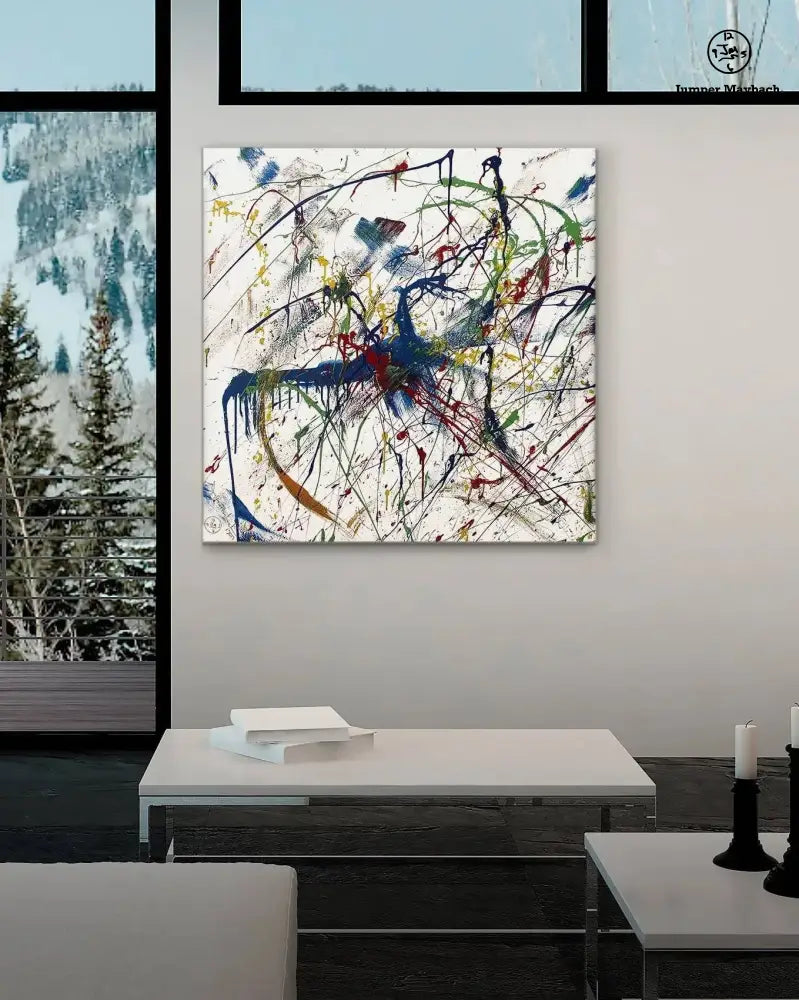
- In Motion 1 is a 36" × 36" acrylic mixed media painting on canvas from the Abstract Series.
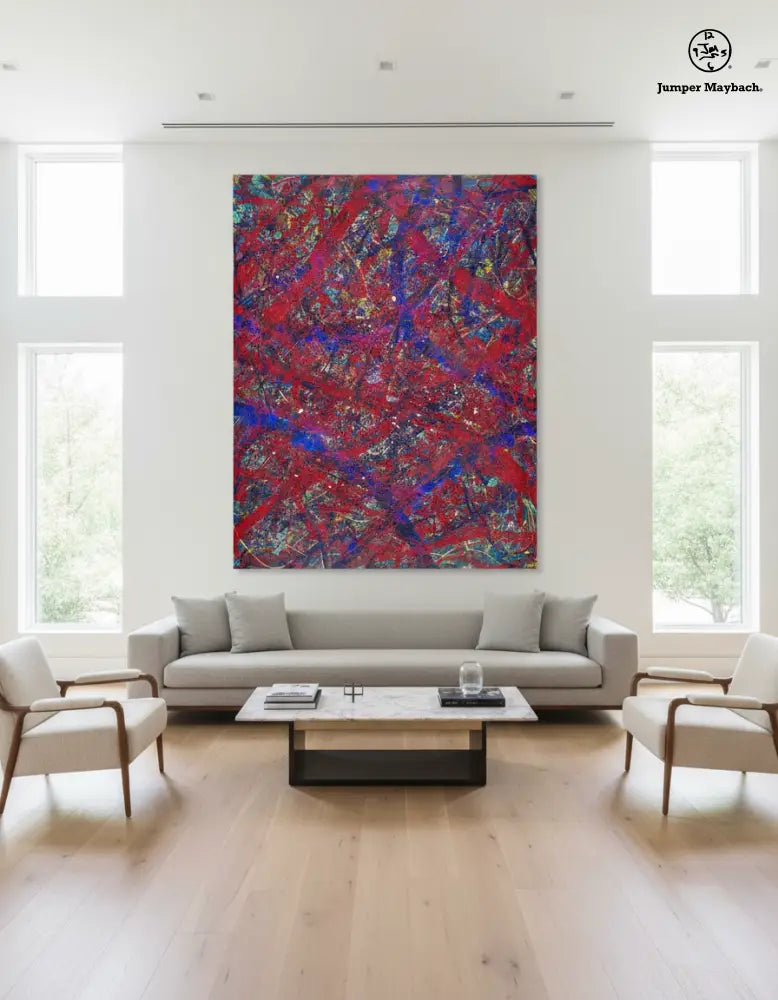
- Inertia is a 48" × 60" × 1.5" mixed media work on canvas from the Trajectories Series.
- Keep art out of direct sun and consult a qualified conservator for anything beyond light dusting.
Table of Contents
- Gestural Abstract Paintings for Contemporary Interiors: What They Mean
- How to Choose Abstract Art for a Room
- Abstract Painting Size Guide: Scale, Proportion, and Placement
- See Gestural Abstract Paintings in Person at the Houston Studio
- Frequently Asked Questions
Gestural Abstract Paintings for Contemporary Interiors: What They Mean
The meaning sits in that movement; a gestural painting preserves an action rather than depicting a thing.
That distinction matters when choosing art for a contemporary interior: you are buying energy, surface, and a moment that will not repeat.
Jumper Maybach's original paintings are acrylic mixed media on canvas. The painting surface itself is the subject of the piece.
Gestural, geometric, and tonal: how the three differ
Most abstract art you will see in contemporary interiors falls into one of three families. Knowing which one you are looking at changes how you hang it.
| Type | What you see | What it does in a room | Best for |
|---|---|---|---|
| Gestural | Sweeping strokes, drips, visible speed | Adds movement and energy; pulls the eye | Focal walls, high-ceiling spaces |
| Geometric | Hard edges, grids, flat shapes | Adds order and calm structure | Minimal rooms, tight palettes |
| Tonal | Soft fields of close-value color | Adds quiet and depth without noise | Bedrooms, reading nooks, low light |
Gestural work is the loudest of the three, and that is the point. It gives a plain wall a center of gravity.
Why movement reads as mood
A gestural canvas gives the eye a path, which is why it can make a still room feel alive and a busy room feel overloaded.
Acrylic mixed media builds surface that raking window light catches differently through the day, which is one honest reason people choose an original over a reproduction.
If you want help reading expressionist brushwork before you shop, our guide on how to interpret abstract expressionism paintings walks through what specific gestures tend to communicate.
How to Choose Abstract Art for a Room
Choosing abstract art for a room comes down to three checks, in this order: scale against the wall, color against the fixed finishes, and energy against how the room is used. Get scale wrong and nothing else rescues it.
Start with the wall, not the artwork.
Then look at what you cannot change: floor tone, wall color, the largest piece of furniture, and the light.
Energy is the check most people skip.
For professional guidance on scale, palette, and placement, our notes for interior designers sourcing abstract paintings cover the decisions that come up most often on residential projects.
A simple selection checklist
Watch out: buying by image alone can lead to a poor fit. Dimensions are not a detail; they are half the decision.
If you are pairing art with mid-century furniture, our guide on matching abstract art colors with mid-century modern furniture goes deeper on palette pairing.
Original paintings vs. giclée prints
Buyers often ask how these two options differ, and they serve different purposes.
An original painting is a one-of-a-kind work made by the artist's hand. Jumper Maybach's listed original paintings are completed, existing works available for immediate acquisition.
A giclée print is a reproduction of an existing artwork.
| Consideration | Original painting | Giclée print |
|---|---|---|
| Uniqueness | One of a kind | Reproduced image |
| Surface texture | Actual paint and mixed media | Printed surface |
| Documentation | Confirm per piece | Confirm per piece |
| Best for | Collectors, focal walls | Accessible entry, rotating display |
Neither choice is inferior. A first print is a legitimate way to start living with art.
Sizing up two originals
Two works currently in the studio show how scale changes the decision.
In Motion #1 is a 36" × 36" acrylic mixed media painting on canvas from the Abstract Series.
Inertia is a 48" × 60" × 1.5" mixed media work on canvas from the Trajectories Series.
Both are original, one-of-a-kind paintings available for immediate acquisition. Private commissions are accepted; inquire at sales@jumpermaybach.com.
Abstract Painting Size Guide: Scale, Proportion, and Placement
The right size for an abstract painting is the largest piece the wall can carry without crowding the furniture around it.
Here is a process to follow, in order:
- Measure the available wall width. Exclude doors, windows, and built-ins.
- Measure the anchor furniture. Sofa, console, bed, or sideboard.
- Set a target width. Aim for art spanning about two-thirds of the anchor's width as a starting point.
- Check the height budget. Leave breathing room above and below; a piece that touches the ceiling or the furniture reads as cramped.
- Set hanging height. Eye level for a standing viewer is a common reference, adjusted for the room.
- Confirm the piece's listed dimensions against your numbers before you commit.
For a large wall, the 48" × 60" size of Inertia is one reference; for a tighter wall, the 36" × 36" size of In Motion #1 is another.
Proportion matters as much as size: a small square canvas on a very wide wall floats, and an oversized piece on a narrow wall feels blocked in.
Placement rules worth keeping
- Hang the center of the piece at a consistent height across a room
- Give a large gestural work its own wall rather than pairing it with shelves
- Keep raking light in mind: side light reveals texture, direct sun does not
Watch out: hanging a heavy large-format canvas on drywall without locating the studs is a real risk. Use appropriate hardware for the weight and, for a piece this size, consider a professional installer.
Caring for gestural work in a Houston climate
Keep art out of direct sun and consult a qualified conservator for anything beyond light dusting.
See Gestural Abstract Paintings in Person at the Houston Studio
Scale and surface are hard to judge on a screen, and gestural work is the hardest of all to evaluate remotely.
Jumper Maybach works from Winter Street Studios, Studio C125, at 2101 Winter Street, Houston, TX 77007.
For buyers outside Houston, the same advice holds: ask for dimensions, additional photographs in different light, and clear documentation for the specific piece before you decide.
Seeing a gestural painting at full scale settles questions that photographs cannot.
Frequently Asked Questions
What makes a painting feel gestural?
A painting feels gestural when the artist's physical movement is visible in the surface. Look for free sweeping gestures, visible brushstroke ridges, splattering, pouring, and spontaneous mark-making that record speed and direction. In Jumper Maybach's In Motion #1, acrylic mixed media layers build a composition of kinetic energy across a 36 by 36 inch canvas. The energy comes from how the paint was applied, not from a depicted subject.
Should you choose an original abstract painting or a giclée print?
Original abstract paintings are one-of-a-kind works with physical texture and surface presence. Giclée prints are reproductions of existing artwork and offer a way to live with a composition at a lower cost. Check what each listing states about edition status, signature, and Certificate of Authenticity before buying. At Jumper Maybach, Clown Migraine is a one-of-a-kind original that includes a certificate of authenticity.
How do you size abstract art for a wall?
Start with the wall, not the frame. Measure the width of the furniture or architectural feature the work will anchor, then aim for artwork that fills roughly two-thirds to three-quarters of that width so the piece reads as a focal point rather than a stamp. Leave breathing room above and below. For scale reference, Inertia measures 48 by 60 inches and Settling Storm matches it.
